

- Fellow of the Royal Society
-
Royal Society
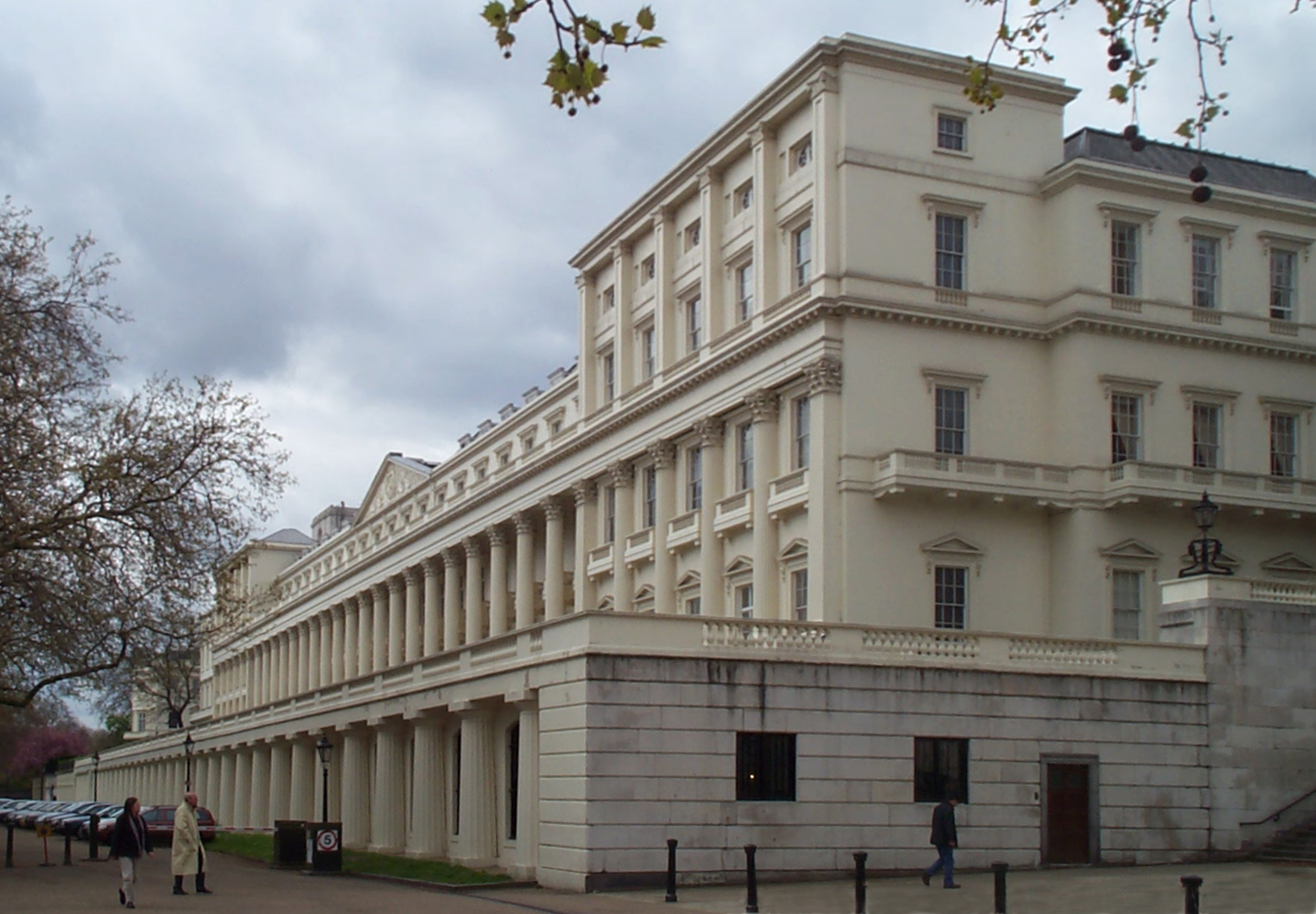
 Le bâtiment de la Royal Society à Londres.

La Royal Society, dont le nom officiel est Royal Society of London for the Improvement of Natural Knowledge et que l'on peut traduire par Société royale de Londres, est une institution fondée en 1660 siégant à Londres et destinée à la promotion des sciences. Elle est l’équivalent de l’Académie des sciences en France.
La Royal Irish Academy, fondée en 1782, lui est affiliée. La Royal Society of Edinburgh, fondée en 1783, est une institution écossaise indépendante.
Sommaire
Membres célèbres
De très nombreux savants ont contribué à la création et à l'essor de la Royal Society. Elle compte parmi les membres fondateurs Robert Boyle, John Evelyn, Robert Hooke, William Petty, John Wallis, John Wilkins, Thomas Willis, Jean Chardin et Christopher Wren. Isaac Newton y présenta sa théorie de l’optique, avant d’en devenir plus tard le président.
Par sa devise Nullius in verba, la Royal Society affirme sa volonté d'établir la vérité dans le domaine scientifique sans recourir à l'autorité et en se fondant exclusivement sur l’expérience. Bien que cette intention paraisse de nos jours évidente, ces fondements philosophiques s'écartent radicalement de ceux que l’on observait par exemple dans la scolastique, où la vérité scientifique était fondée sur la logique déductive en accord avec la divine providence et avec l'appui des autorités anciennes, comme Aristote.
Liste sélective de présidents
Article principal : Présidents de la Royal Society.- Christopher Wren (1680-1682)
- Samuel Pepys (1684-1686)
- Isaac Newton (1703-1727)
- Joseph Banks (1778-1820)
- Lord Rosse (1848-1854)
- Joseph Dalton Hooker (1873-1878)
- Thomas Henry Huxley (1883-1885)
- George Stokes (1885-1890)
- Lord Kelvin (1890-1895)
- Ernest Rutherford (1925-1930)
- Robert May (2000-2005)
- Martin Rees (depuis 2005 pour 5 ans)
Chronologie
 Les armes de la Royal Society sur un vitrail avec la devise Nullius in verba.
- Années 1640 : Premières rencontres informelles
- 1660 : Fondation le 28 novembre à Gresham College
- 1661 : Le nom de la Royal Society apparaît pour la première fois imprimé, et la bibliothèque reçoit ses premiers livres.
- 1662 : La charte royale autorise la Royal Society à publier des livres
- 1663 : Une deuxième charte royale est accordée à la Royal Society
- 1665 : Première parution des Philosophical Transactions
- 1666 : Le grand incendie de Londres oblige la Royal Society à déménager à Arundel House
- 1669 : Troisième charte royale ; la proposition de faire du Chelsea College le siège de la Royal Society est rejetée pour construire à la place le Chelsea Hospital
- 1673 : Retour à Gresham College [1]
- 1710 : La Royal Society achète son siège à Crane Court
- 1780 : Déménagement sur le site de Somerset House fourni par la couronne [2]
- 1847 : Changement des critères de sélection pour s’assurer que les futurs membres seront élus exclusivement sur la base de leur mérite scientifique
- 1850 : Première subvention de £1 000 du parlement britannique pour aider les scientifiques dans leurs recherches et acheter des équipements
- 1857 : Déménagement à Burlington House dans le quartier de Piccadilly
- 1967 : Déménagement à son siège actuel de Carlton House Terrace
Médailles, leçons magistrales prestigieuses et prix
Médailles
Ces médailles récompensent chaque année (ou tous les deux ou trois ans suivant la médaille) des recherches couvrant tous les domaines de la science. Elles sont au nombre de dix :
- Médaille Buchanan, créée en 1897 - sciences médicales
- Médaille Copley, créée en 1731 - toutes les branches de la science
- Médaille Darwin, créée en 1890 - sciences biologiques dans lesquelles Darwin a travaillé
- Médaille Davy, créée en 1877 - sciences chimiques
- Médaille Gabor, créée en 1989 - sciences de la vie : biologie moléculaire et ingénierie génétique
- Médaille Hughes, créée en 1902 - sciences physiques : électricité et magnétisme
- Médaille Leverhulme, créée en 1960 - chimie pure et appliquée
- Médaille Royale, créée 1826 - sciences naturelles et appliquées
- Médaille Rumford, créée en 1800 - propriétés optique et thermique de la matière
- Médaille Sylvester, créée en 1901 - recherches mathématiques
Leçons magistrales Prestigieuses
Nationales
- Bakerian Lecture
- Clifford Paterson Lecture
- Crick Lecture
- Croonian Lecture, attribuée pour le première fois en 1738
- Ferrier Lecture
- Leeuwenhoek Lecture
- Wilkins-Bernal-Medawar Lecture
Internationales
- Blackett Memorial Lecture
- Claude Bernard Lecture
- Humphry Davy Lecture
- Rutherford Memorial Lecture
- UK-Canada Rutherford Lecture
Historiques
- Esso Energy Award
- Florey
- Philips Lecture
- Pilgrim Trust
- Tercentenary
- Bernal
- Medawar
- Wilkins lecture
Prix
- Armourers & Brasiers’ Prize
- GlaxoSmithKline Prize and Lecture
- Hauksbee Awards
- Kohn Award
- Michael Faraday Prize
- Mullard Award
- Pfizer Award
- Rosalind Franklin Award
- Prix Microsoft
- Kohn Award
Bibliographie
- Morris Berman, Social Change and Scientific Organization: Royal Institution, 1799-1844, Heinemann, Londres, 1978, xxv + 224 p. (ISBN 0-435-54060-2)
Voir aussi
Articles connexes
Liens externes
- (en) Site officiel
- (en) Site de la Royal Irish Academy
 Portail du Royaume-Uni
Catégories : Royal Society | Société savante | Société savante britannique


Wikimedia Foundation. 2010.
