Décaborane
- Décaborane
-
| Décaborane |
 |
| Général |
| Nom IUPAC |
Décaborane (14) |
| Synonymes |
Boron hydride (B10H14), Décaborane |
| No CAS |
17702-41-9 |
| No EINECS |
241-711-8 |
| Apparence |
Cristaux incolores à blancs, d'odeur acre. |
| Propriétés chimiques |
| Formule brute |
H14B10
|
| Masse molaire[1] |
122,221 ± 0,071 g·mol-1
H 11,55 %, B 88,45 %,
122.221 g/mol |
| Propriétés physiques |
| T° fusion |
99,6 °C |
| T° ébullition |
213 °C |
| Solubilité |
Faiblement soluble dans l'eau froide, hydrolysé dans l'eau chaude |
| Masse volumique |
0,94 g·cm-3 |
| T° d'auto-inflammation |
149 °C |
| Point d’éclair |
80 °C |
| Précautions |
|
Directive 67/548/EEC
|
|
Numéro index :
241-711-8">241-711-8]
Phrases R :
R11 : Facilement inflammable.
R26 : Très toxique par inhalation.
R24/25 : Toxique par contact avec la peau et par ingestion.
Phrases S :
S9 : Conserver le récipient dans un endroit bien ventilé.
S45 : En cas d’accident ou de malaise, consulter immédiatement un médecin (si possible, lui montrer l’étiquette).
S36/37/39 : Porter un vêtement de protection approprié, des gants et un appareil de protection des yeux/du visage.
|
| Phrases R : 11, 24/25, 26, |
| Phrases S : 9, 36/37/39, 45, |
|
Transport
|
Code Kemler :
46 : matière solide inflammable ou auto-échauffante, toxique
Numéro ONU :
1868 : DÉCABORANE
Étiquettes :
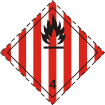
 4.1
4.1 : Matières solides inflammables, matières autoréactives et matières solides explosibles désensibilisées
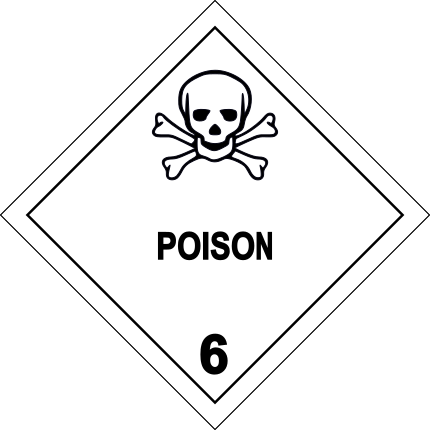
 6.1
6.1 : Matières toxiques
Emballage :
Groupe d'emballage II : matières moyennement dangereuses;
|
|
NFPA 704
|
|
|
| Inhalation |
Toux, vertiges, somnolences, maux de tête, transpiration, nausées, mal de gorge, faiblesse, tremblements, Incoordinations. |
| Peau |
Peut être absorbé. Rougeurs. |
| Yeux |
Rougeurs. |
| Ingestion |
(Voir inhalation) |
| Écotoxicologie |
| Seuil de l’odorat |
bas : 0,06 ppm[2] |
|
Unités du SI & CNTP, sauf indication contraire.
|
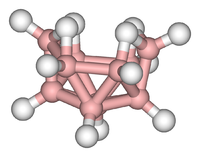
Le décaborane(14), également appelé décaborane, est un composé de la famille des boranes et de formule B10H14.
Propriétés et structure
Le décaborane est un solide inflammable dont la couleur varie d'incolore à blanc. Il est caractérisé par une odeur piquante légèrement chocolatée sensible à partir d'1 ppm. C'est un produit peu stable, donc très réactif[3]. Le décaborane est composé de 10 atomes de bore et 14 atomes d'hydrogènes pouvant être soit fermé (closo) soit ouvert (nido et arachno).
Notes et références
Wikimedia Foundation.
2010.
Contenu soumis à la licence CC-BY-SA. Source : Article Décaborane de Wikipédia en français (auteurs)
Regardez d'autres dictionnaires:
Decaborane — Other names decaborane decaboron tetradecahydride … Wikipedia
decaborane — noun The stable borane BH … Wiktionary
17702-41-9 — Décaborane Décaborane Général Nom IUPAC Décaborane (14) Synonymes … Wikipédia en Français
Carborane — Ball and stick model of o carborane … Wikipedia
Borane — Traduction à relire Borane → Borane (+) … Wikipédia en Français
Borane — In chemistry, a borane is a chemical compound of boron and hydrogen. The boranes comprise a large group of compounds with the generic formulae of BxHy. These compounds do not occur in nature. Many of the boranes readily oxidise on contact with… … Wikipedia
Pentaborane — Chembox new ImageFile = Pentaborane.png ImageFile1 = Pentaborane 3D balls.png IUPACName = Pentaborane(9) OtherNames = Pentaborane Section1 = Chembox Identifiers CASNo = 19624 22 7 PubChem = SMILES = Section2 = Chembox Properties Formula = B5H9… … Wikipedia
List of inorganic compounds — Tentative listing related to this page, inorganic compounds by element (presently under construction), as well as . This list is not necessarily complete or up to date ndash; if you see an article that should be here but isn t (or one that… … Wikipedia
carborane — /kahr beuh rayn /, n. any of the crystalline compounds obtained by the substitution of carbon for boron in borane. [b. CARBON and BORANE] * * * ▪ chemical compound Introduction any member of a class of organometallic compounds containing… … Universalium
Inorganic chemistry — For the journal, see Inorganic Chemistry (journal). Inorganic compounds show rich variety: A: Diborane features unusual bonding B: Caesium chloride has an archetypal crystal structure C: Fp2 is an organometallic complex D … Wikipedia