

- 50 And
-
Upsilon Andromedae
υ Andromedae 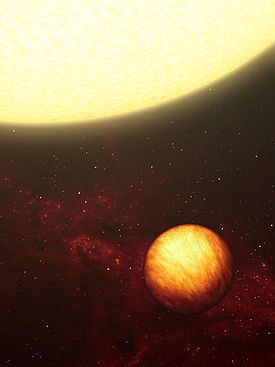
Données d'observation
(Époque J2000.0)Ascension droite 01h 36m 47,8s Déclinaison +41° 24′ 20″ Constellation Andromède Magnitude apparente +4,09 Caractéristiques Type spectral F8V Indice U-B 0,06 Indice B-V 0,54 Indice R-I 0,30 Variabilité aucune Astrométrie Vitesse radiale -28,9 km/s Mouvement propre μα=-172,57 mas/a
μδ=-381,03 mas/aParallaxe 74,25 ± 0,72 mas Distance 43,9 ± 0,4 al
(13,47 ± 0,13 pc)Magnitude absolue 3,96 Caractéristiques physiques Masse 1,28 M☉ Rayon 1,6 R☉ Gravité de surface (log g) 3,83 Luminosité 3,4 L☉ Température 6 095 K Métallicité 100 % du Soleil Rotation (~10 jours) ~8 km/s Âge 3,3×10⁹ a Autres désignations 50 Andromedae (Flamsteed), GJ 61, HR 458, BD+40 332, HD 9826, LTT 10561, GCTP 331.00, SAO 37362, FK5 1045, CCDM 01367 +4125, WDS 01368+4124A, HIP 7513, GC 1948 Upsilon [υ] Andromedae est une étoile binaire, distante de 44 années-lumière dans la constellation d'Andromède.
Le système contient une naine jaune-blanche (Upsilon Andromedae A) similaire au Soleil et une faible naine rouge (Upsilon Andromedae B). Les deux étoiles sont séparées de 750 unités astronomiques (UA). Upsilon Andromedae A est de type spectral F8V, légèrement plus jeune, plus massive et lumineuse que le Soleil mais avec la même métallicité [1] et le même rayonnement ultraviolet..[2]
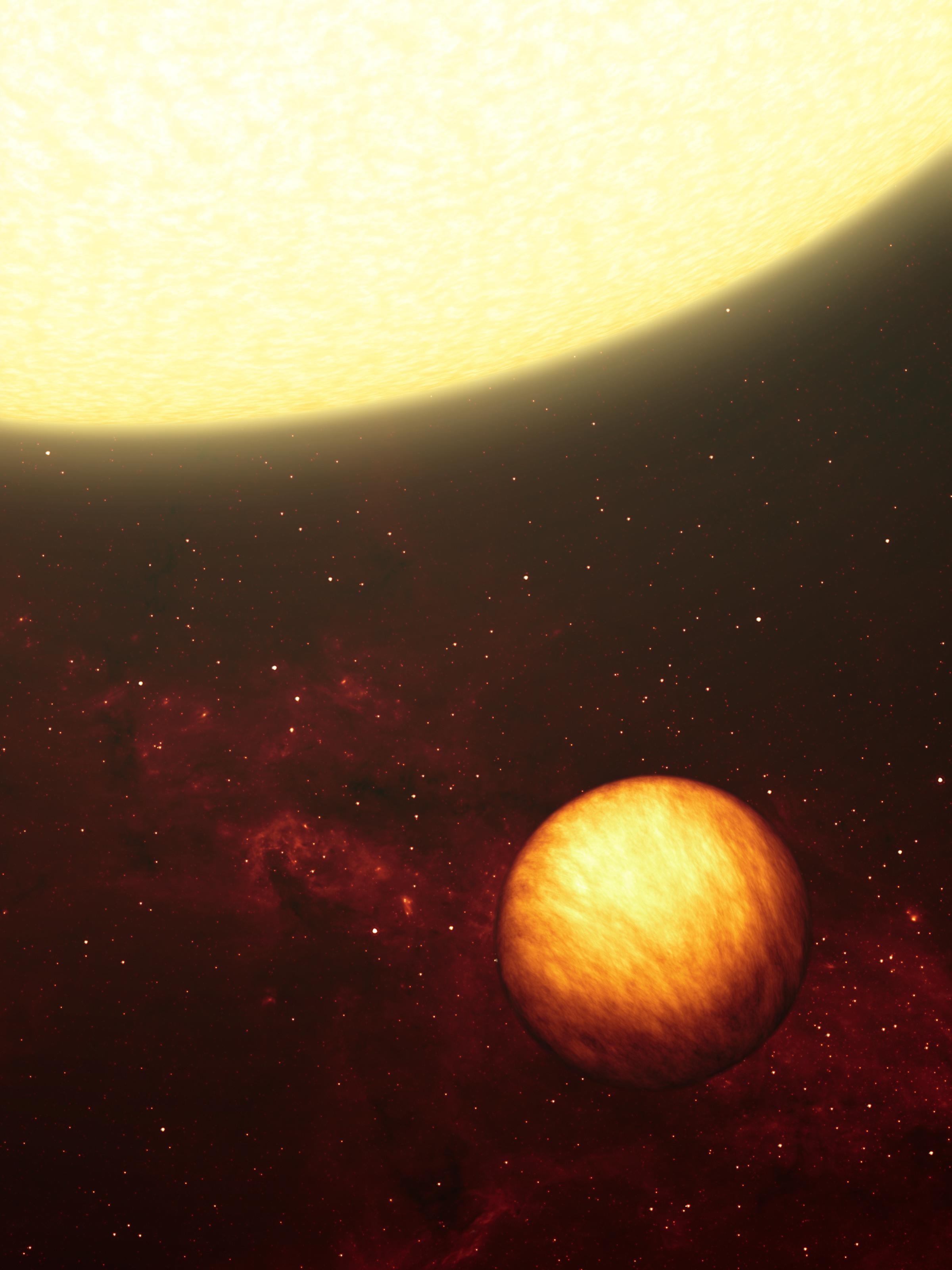
Depuis 1997, trois exoplanètes ont été découvertes en orbite d'Upsilon Andromedae A. Toutes trois sont de masses comparables ou supérieures à Jupiter.
Upsilon Andromedae a été à la fois le premier système planétaire possédant plusieurs planètes découvert au tour d'une étoile de la séquence principale et autour d'une étoile double.
Upsilon Andromedae A est classée 21e sur la liste des 100 étoiles « cibles » de la mission Terrestrial Planet Finder de la NASA.[3]
Sommaire
Système planétaire
La planète la plus proche (0,06 UA) d'Upsilon Andromedae A Upsilon Andromedae b, a été découverte en mesurant les variations de vitesse radiale de l'étoile due à la gravité et parait être responsable d'une activité renforcée de la chromosphère de son étoile.[4]
Deux planètes plus éloignées furent découvertes et baptisées Upsilon Andromedae c et d à 0,8 et 2,54 UA respectivement, avec des orbites plus excentriques que Pluton [5]. Upsilon Andromedae d est dans la zone habitable du système, à une inclinaison de 155° et une masse de 9 à 10 fois celle de Jupiter.[6]
L'existence d'autres planètes trop petites ou plus distantes n'est pas écarté, bien que la présence de b, c, d, aussi près de leur étoile rendrait le système instable.[7] Des simulations montrent que l'excentricité de ce système peut avoir été due à une rencontre entre c et une 4e planète qui a été éjectée ou détruite.[8] D'ailleurs une upsilon andromedae e, est listée comme planète hypothétique : Simbad.
Caractéristiques des planètes du système Upsilon Andromedae. Planète Masse Période orbitale (en jours) Axe semi-majeur Excentricité Upsilon Andromedae b >0.687 ± 0.058 4.617113 ± 0.000082 0.0595 ± 0.0034 0.023 ± 0.018 Upsilon Andromedae c >1.97 ± 0.17 241.23 ± 0.30 0.830 ± 0.048 0.262 ± 0.021 Upsilon Andromedae d >3.93 ± 0.33 1290.1 ± 8.4 2.54 ± 0.15 0.258 ± 0.032 En astronomie chinoise, cette étoile fait partie de l'astérisme Tianda jiangjun, représentant un militaire de haut rang éventuellement accompagné de ses hommes.
Voir aussi
Références
- ↑ http://vizier.u-strasbg.fr/viz-bin/VizieR-5?-out.add=.&-source=V/117/table1&recno=970 , Record 970, Geneva-Copenhagen Survey of Solar neighbourhood, Nordstrom et al, 2004
- ↑ Buccino, A. et al., « Ultraviolet Radiation Constraints around the Circumstellar Habitable Zones », dans Icarus, vol. 183, no 2, 2006, p. 491 – 503 [résumé]
- ↑ TPF-C Top 100, « #12 HIP 7513 »
- ↑ Shkolnik, E. et al., « Hot Jupiters and Hot Spots: The Short- and Long-term Chromospheric Activity on Stars with Giant Planets », dans The Astrophysical Journal, vol. 622, 2005, p. 1075 – 1090 [résumé]
- ↑ Butler, R. et al., « Catalog of Nearby Exoplanets », dans The Astrophysical Journal, vol. 646, 2006, p. 505 – 522 [résumé] (web version)
- ↑ Han, I. et al., « Preliminary Astrometric Masses for Proposed Extrasolar Planetary Companions », dans The Astrophysical Journal, vol. 548, 2001, p. L57 – L60 [résumé]
- ↑ Lissauer, J., Rivera, E., « Stability analysis of the planetary system orbiting υ Andromedae. II. Simulations using new Lick observatory fits », dans The Astrophysical Journal, vol. 554, 2001, p. 1141 – 1150 [résumé]
- ↑ Ford, E. et al., « Planet-planet scattering in the upsilon Andromedae system », dans Nature, vol. 434, 2005, p. 873 – 876 [résumé]
Liens externes
- (en) HD 9826 -- High proper-motion Star sur la base de données Simbad du Centre de données astronomiques de Strasbourg
- (en) 2MASS J01365042+4123325 -- Star sur la base de données Simbad du Centre de données astronomiques de Strasbourg
- (en) Extrasolar Planets Encyclopaedia: Notes for star Ups And
- (en) SolStation: Upsilon Andromedae 2
- (en) SFSU: Upsilon Andromedae
- (en) Harvard-Smithsonian CfA: Upsilon Andromedae
- (en) Extrasolar Visions: Upsilon Andromedae
- (en) SpaceDaily: How The Orbits Of Extrasolar Planets Became So Eccentric
- (en) James B. Kaler, « Upsilon Andromedae » sur Stars
- (en) Astro Encyclopedia: Upsilon Andromedae
 Portail de l’astronomie
Catégories : Constellation d'Andromède | Étoile binaire | Naine jaune-blanche | Naine rouge | Système planétaire
Wikimedia Foundation. 2010.
